
Mechanical Shock Test
EquipmentMechanical Shock Test Equipment
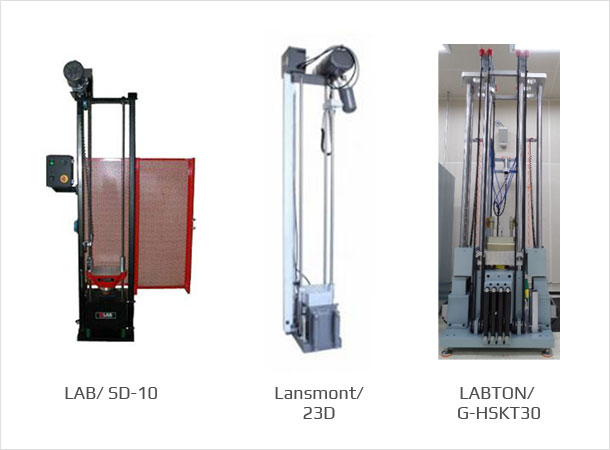
LAB/ SD-10 , Lansmont/ 23D, LABTON/ G-HSKT30
A shock test simulates impacts that can occur during manufacturing,transportation, and use.
Introduction
The shock test applies stress by changing the samples' acceleration momentarily without it making direct contact. For example, the shock waves generated when the door is opened is closed are transferred to components mounted inside the door. At this point, the net acceleration occured is classified as Mechanical Shock. Shock tests provide particularly important information for evaluating the reliability of portable electronic components. Additionally, shockwaves and peak acceleration can be adjusted to better simulate shock in various circumstances and mechanisms.
Application
After the application of lead-free solder, evaluating open defects in joints caused by shock tests have become mandatory. Additionally, vibration, high temperature, thermal cycle, and repeated bending tests are varied to evaluate the solder joint's reliability.
The Equipment
Mechanical Shock Test Equipment
-
- Inspection Equipment
Dip and Look, Wetting balance Test Equipment
-
- Manufacturer / Model
-
LAB/ SD-10
Lansmont/ 23D
LABTON/ G-HSKT30
-
- USE
-
A shock test simulates impacts that can occur during manufacturing,transportation, and use
-
- Equipment Spec
-
LAB/SD-10 : Max. Acceleration – 3,500 G
Lansmont/ 23D : Max. Acceleration – 10,000 G
LABTON/ G-HSKT30 : Max. Acceleration – 30,000 G
Test Method
The shock test applies stress by changing the samples' acceleration momentarily without it making direct contact. For example, the shock waves generated when the door is opened is closed are transferred to components mounted inside the door. At this point, the net acceleration occured is classified as Mechanical Shock. Shock tests provide particularly important information for evaluating the reliability of portable electronic components. Additionally, shockwaves and peak acceleration can be adjusted to better simulate shock in various circumstances and mechanisms. After the application of lead-free solder, evaluating open defects in joints caused by shock tests have become mandatory. Additionally, vibration, high temperature, thermal cycle, and repeated bending tests are varied to evaluate the solder joint's reliability.
DATA EXAMPLE

Technical Use Case
Related Standards
- JESD22-B110
- JESD22-B111
- AEC-Q100
- AEC-Q101
- AEC-Q102
- AEC-Q200
- MIL-STD-883 Method 2002.5