
Constant Acceleration
EquipmentAccelerator Equipment
Daekyung Enginnering / DKS-1000
A test that exposes component level products under rotation and constant acceleration
Introduction
This test is used to evaluate the physical effects of the semiconductor component from the stress caused by centrifugal force. This is an accelerated assessment test designed to identify structural and mechanical vulnerabilities of the product that was undetected by the shock and vibration test. The test can be applied as a destruction test by applying a high level of stress to determine the mechanical limit of the product's package, internal metal, lead, die and substrate. This assessment can be used as a means of pre-removing products with lower mechanical properties, and is considered a mandatory assessment, especially for automotive parts crucial for human safety.
Application
Evaluation of rotational and constant acceleration of vehicles and U.S. Defense Component Level products.
The Equipment
Constant Acceleration
-
- Manufacturer / Model
Daekyung Enginnering / DKS-1000
-
- USE
-
Rotation and Constant Acceleration Testing of Component Level Products
-
- Equipment Spec
-
Acceleration Range : 15 000 ~ 30 000 G

Test Method
This test is used to evaluate the physical effects of the semiconductor component from the stress caused by centrifugal force. This is an accelerated assessment test designed to identify structural and mechanical vulnerabilities of the product that was undetected by the shock and vibration test. The test can be applied as a destruction test by applying a high level of stress to determine the mechanical limit of the product's package, internal metal, lead, die and substrate. This assessment can be used as a means of pre-removing products with lower mechanical properties, and is considered a mandatory assessment, especially for automotive parts crucial for human safety.
DATA EXAMPLE
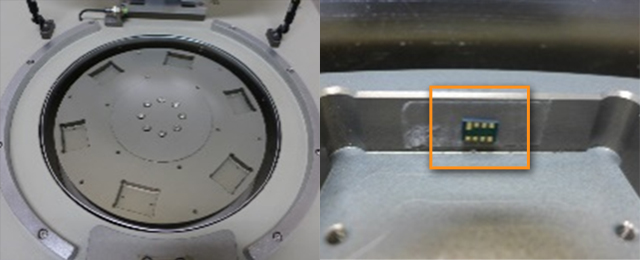
Before test
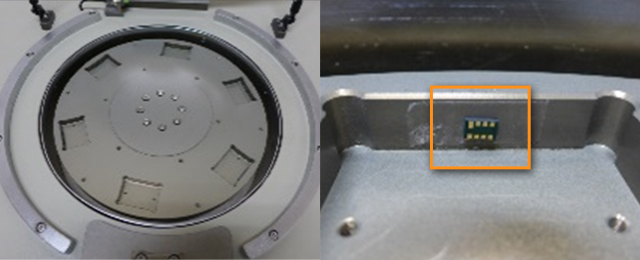
After test
Technical Use Case
Related Standards
- AEC Q100
- MIL-STD-883 Method 2001
- AEC Q101
- MIL-STD-750 Method 2006
- AEC Q106
- MIL-STD-202 Method 206