System Configuration
-
Main Control Module
-
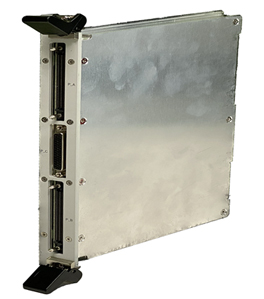
The main module uses FPGA-based controllers optimized for SEE Test and Analysis and generates high-speed digital control and data lines. The main module is optimized for test generation and result comparison for various radiation test algorithms.
Key Features
- I/0 Digital Line: 240 Pint
- I/0 Digital Voltage: 1.1V to 5V Change
- Ethernet-based Module Communication
- Applications: Memory (DRAM, SRAM, NAND), SoC
-
Core SSD Module (SSD-only test module)
-
The module is CPU-based controller and performs radiation tests of NVME SSD products.
Key Features
- NVME-enabled ports: 1 ea
- NVME voltage: 3.0V to 3.5V changeable, 12V support
- Ethernet-based Module Communication
- Applications: M.2, U, 2E.1 SSD

-
Core Power Device Module (Power device dedicated test module)
-
The main module uses FPGA-based controllers and provides a communication protocol for the gate of the Power Device, real-time microcurrent measurement of the drain end, and power device functional operation.
Key Features
- Ethernet-based Communication Bus
- Applications: Power Diode, Power MOSFET, IGBT
-
DC Power Supply Module (Multifunction Power Supply Module)
-
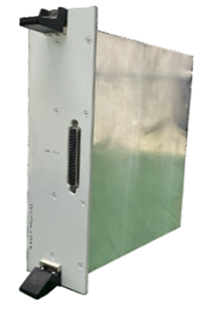
The Programmable Power Supply system provides stable power and regulates the voltage for the DUT. It performs voltage and current measurements and controls multiple power output channels.
Key Features
- Voltage control channel: 2 CH (distributed to 6 output channels per PPS)
- Voltage output channel: 12 CH
- Voltage control range: 0~28V
- Ethernet-based Module Communication

-
QRS SEE Chassis
-
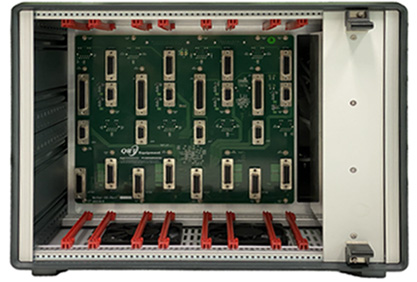
The system's backplane supports power control and management of the module, the system's cooling unit, and the module's communication bus (Ethernet). Optional selection allows multiple slots to be provided in the chassis
Key Features
- Module Communication Bus: Ethernet
- Multi-function power supply module slot: 4 ea
- Digital input/output module slot: 4 ea
-
Control System
-
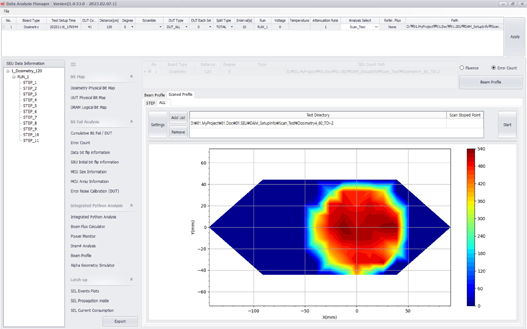
Overall system control, management, and monitoring are performed remotely and the system manages output data in real-time during testing. It provides customized analysis tools for soft error data analysis for accurate and effective results.
Key Features
- Type: Main GUI, various analysis tools, Vector/Test Program SDK

-
Dosimetry
-
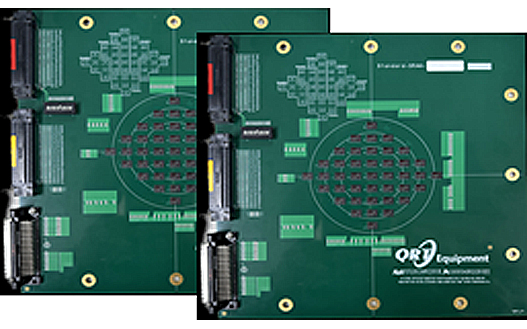
- During accelerated radiation testing, precise measurement of beam flux is essential
- Our dosimetry solution has advanced algorithms to extract intrinsic-SER of the DUT
- The Calibrated DUT is used as a Golden Reference for highly accurate SER test and analysis
- This Dosimetry Board can perform precise beam profile measurement
- Use of the Dosimetry Board opens new chapter in radiation testing with un-parallel accuracy
-
Operating Software
-
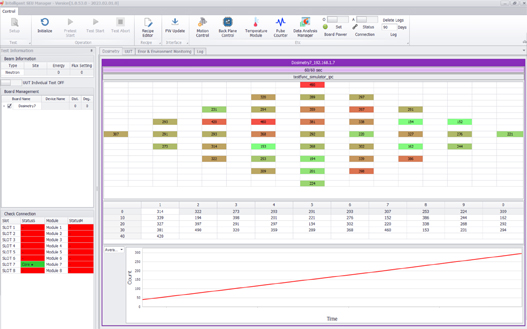
- Remote Test Flow & Execution Management System
- Execute the Test Algorithm for each test condition
- Real-time Control & Monitoring of voltage, current, temp
- Real-time monitoring of test beam flux
- Real-time processing of test results and status logging
-
Soft Error Data Analysis Software
-
- Standard-based test data analysis & certification report generation
- Build Event Bitmap and perform various statistical analyses for accuracy and consistency
- Advanced analysis includes beam profile data, weak points, radiation-induced parametric degradation, and correlation factor to different beams and reference DUT